
Updated for 2026. You bend down to tie your shoes and feel a twinge in your back. Carrying the shopping in from the car leaves your shoulders sore the next day. You’re not unfit — you’re just not trained for the things you actually do.
Most workouts train how you look. Functional fitness trains how you live. Here’s what it actually means, the seven movements it’s built on, and how to start this week.
What functional fitness actually is
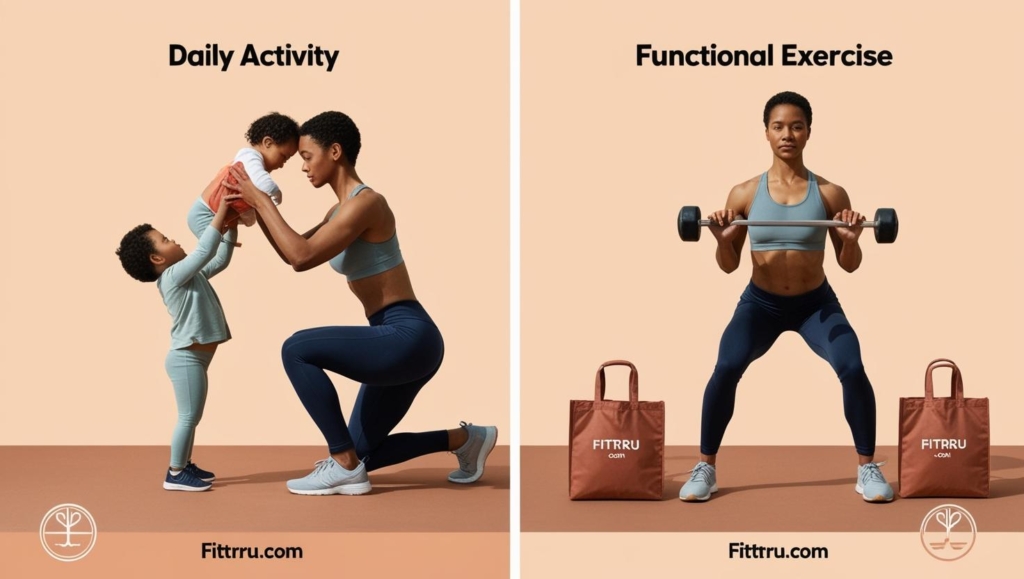
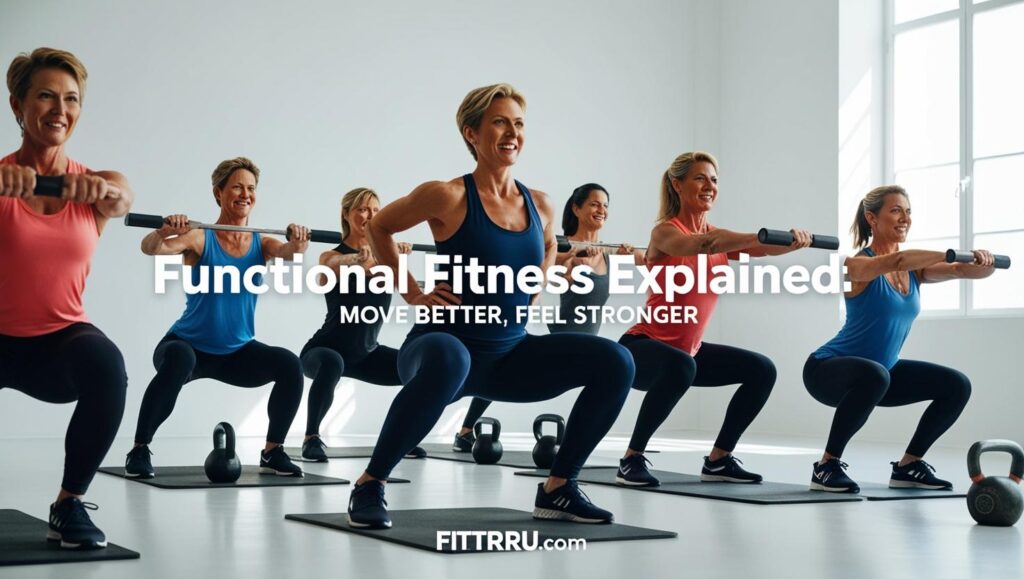
Functional training uses movements that mirror real life — squatting, hinging, pushing, pulling, carrying, rotating. Rather than isolating a single muscle, each exercise coordinates several muscle groups at once, with your core stabilising throughout.
The test is simple: does this exercise make something outside the gym easier? A bicep curl builds a bicep. A farmer’s carry makes the shopping trip easier, strengthens your grip, and teaches your trunk to stay braced under load. Both have a place — but only one transfers.
Functional vs traditional training
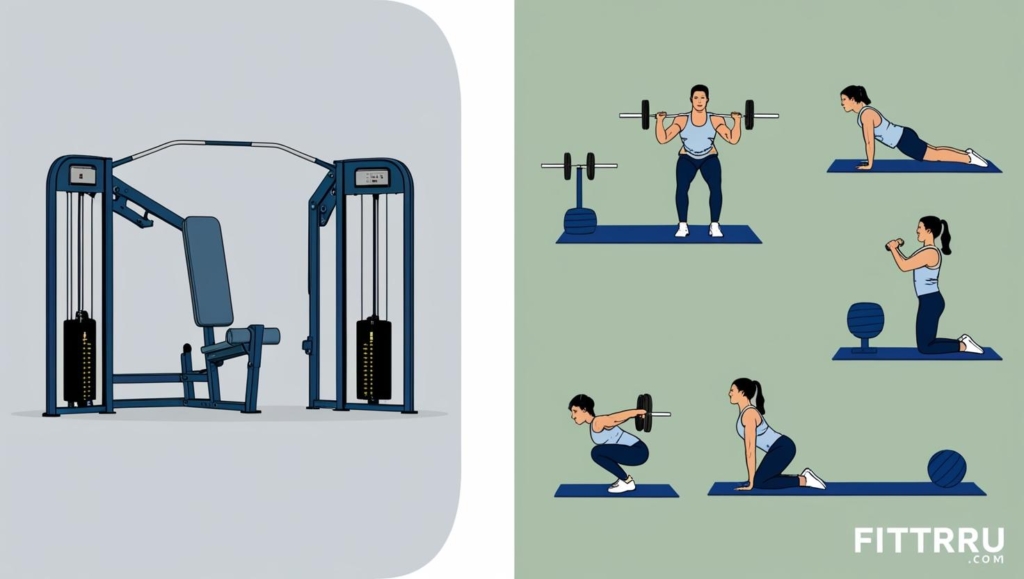
| Traditional training | Functional training |
|---|---|
| Focus on appearance | Focus on movement quality |
| Isolates one muscle | Coordinates several at once |
| Mostly machines, fixed paths | Bodyweight, free weights, bands |
| Mobility often ignored | Builds balance and posture |
| Stability handled by the machine | Stability is the training |
This isn’t an either/or. Machines are excellent for adding volume safely, especially when you’re tired or rehabbing. The problem is a programme built entirely from them — you get stronger in fixed paths and never train the stabilising work that real movement demands.
The seven foundational movements
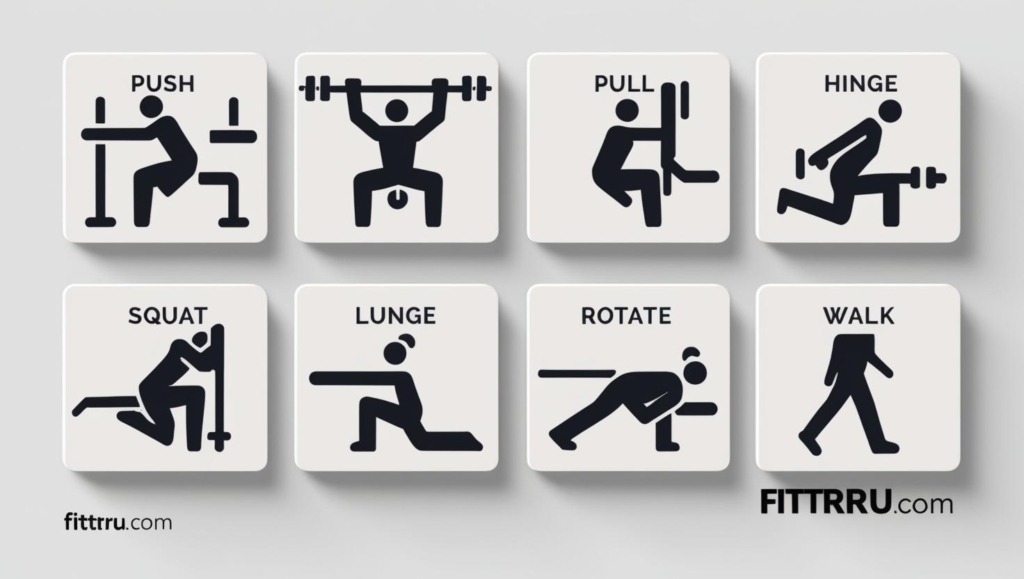
Nearly everything your body does outside the gym is a version of one of these. Cover all seven and you have a complete programme.
- Squat — bodyweight or goblet squat. Real life: standing from a chair, getting off the floor.
- Hinge — deadlift, hip hinge, glute bridge. Real life: lifting anything off the ground. The pattern that protects your back.
- Push — push-up, overhead press. Real life: pushing a heavy door, putting a case in the overhead locker.
- Pull — row, pull-up, band pull-apart. Real life: opening a stuck drawer — and the main counterweight to desk posture.
- Lunge — forward, reverse or lateral. Real life: stairs, stepping over things, catching your balance.
- Carry — farmer’s carry, suitcase carry. Real life: shopping, luggage, a toddler. The most underrated of the seven.
- Rotate / anti-rotate — Pallof press, cable or band chops. Real life: twisting to reach the back seat without tweaking something.
What you actually get from it
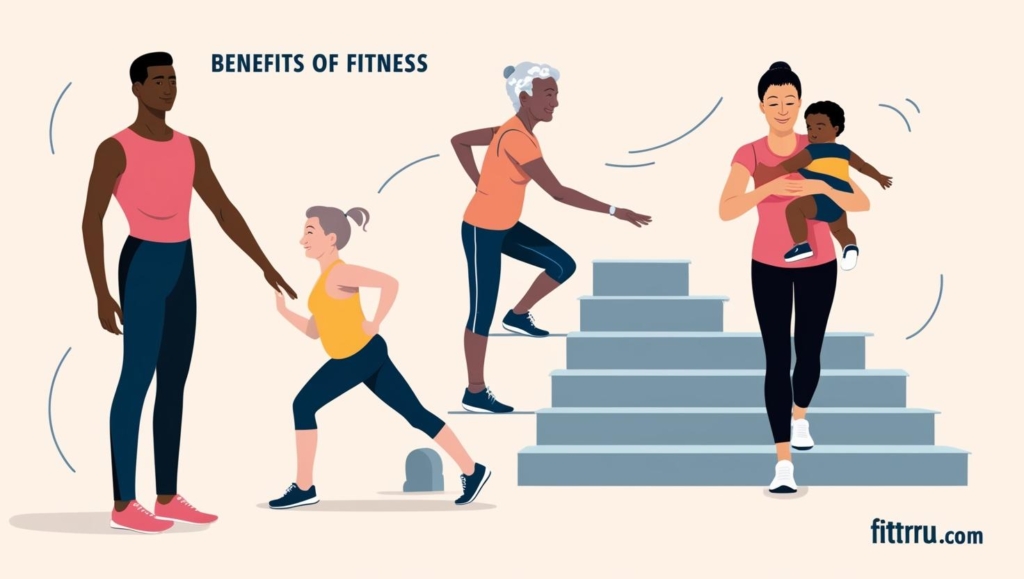
- A core that works while you move, not just while you plank — which is what actually protects your lower back.
- Better balance, because single-leg and carry work train the stabilisers machines do for you.
- Fewer tweaks and strains, since you’re rehearsing the patterns that normally catch you out cold.
- Posture that holds up through a working day, mostly thanks to consistent pulling volume.
- Everyday stamina — the compound nature of the movements means more work in less time.
A simple week to start
Two full-body sessions a week covers all seven patterns. Around 2–3 sets of 8–12 reps each, stopping a couple of reps short of failure.
- Day A — goblet squat · push-up · band row · reverse lunge · farmer’s carry
- Day B — hip hinge or glute bridge · overhead press · single-arm row · lateral lunge · Pallof press
Progress by adding a rep, a set, or a little load each week — not by adding new exercises. Variety feels productive and is usually the enemy of progress.
Common mistakes
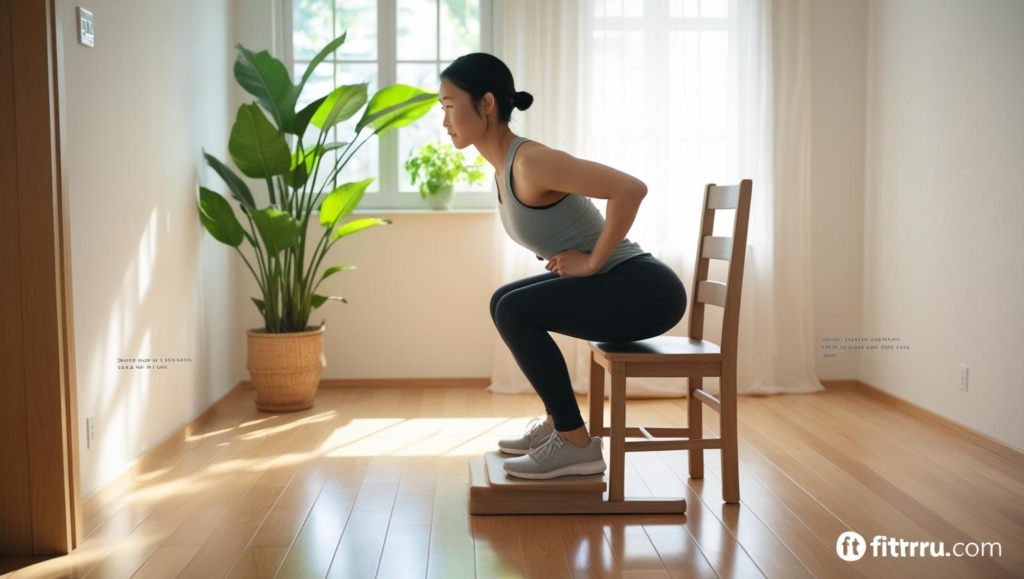
- Confusing unstable with functional. Squatting on a wobble board isn’t more functional — it just makes you worse at squatting. Train stability through carries and single-leg work instead.
- Never adding load. “Functional” doesn’t mean light forever. If it never gets harder, you stop adapting.
- Skipping the hinge. It’s the least intuitive pattern and the one that most protects your back. Learn it properly, ideally with someone watching.
- Turning every session into a conditioning circuit. Rushing compound movements while fatigued is where form breaks down.
Frequently asked questions
Is functional fitness good for beginners?
Yes — arguably it’s the best place to start, because you’re learning the patterns you already use daily rather than isolating muscles you can’t feel.
Do I need equipment?
Not at first. Bodyweight covers squat, hinge, push, lunge and anti-rotation. A pair of adjustable dumbbells or a kettlebell unlocks carries and loaded hinges — see our price-per-pound calculator before buying weights.
Will it build muscle?
Yes, provided you progressively add load and eat enough protein. Compound movements are excellent muscle builders — set your intake with the macro calculator.
Can I combine it with regular lifting?
Easily, and most people should. Keep the big compound lifts and add carries, single-leg work and anti-rotation as accessories.
Setting up somewhere to train at home? Our space planner shows what fits, and the rest are on our free fitness tools page.